Why Cash Handling Is Risky for Elderly Parents in India — A Complete Guide for NRI Families
 India Roots
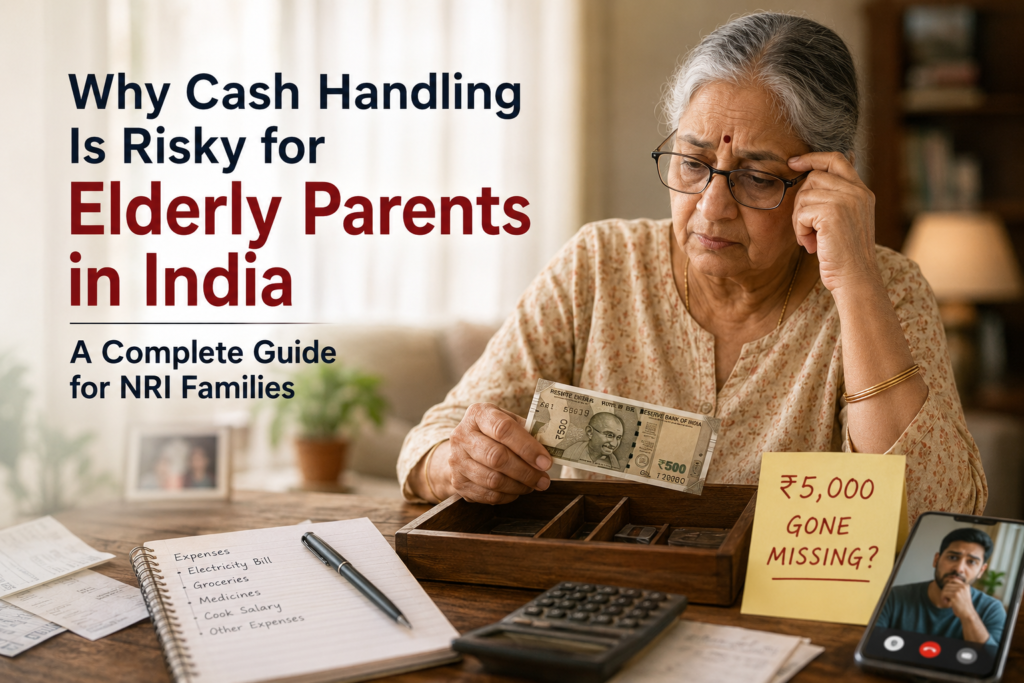
You’re on a video call with your mother on a Sunday evening. She sounds fine. Then, almost as an afterthought, she mentions that ₹5,000 from the kitchen drawer has “gone missing.”
She laughs it off. “Old age, beta. I must have misplaced it.”
You hang up — and the worry doesn’t leave you.
You’re in Canada. She’s in Chandigarh. And there is nothing you can do tonight except wonder: Is this the first time? Is someone taking advantage of her? Is she safe?
This moment plays out in thousands of NRI households every year. And it rarely stays small.
Cash handling is one of the most overlooked risks facing elderly parents living alone in India. The amounts may seem small at first. But the financial loss, emotional stress, and lost independence that follow can quietly snowball — while you’re watching helplessly from thousands of kilometres away.
This guide breaks down exactly what the risks are, why seniors are especially vulnerable, and what NRI families are doing today to protect their parents without taking away their dignity.
Why Your Parents Still Depend on Cash — And Why That’s a Problem
Your parents grew up in a cash economy. Keeping ₹10,000–₹20,000 at home for monthly expenses — groceries, the cook’s salary, medicines, electricity bills — felt completely normal. It still does to them.
That instinct isn’t wrong. But the world around them has changed.
Elderly parents living alone are increasingly targeted for financial exploitation — not because they are careless, but because they are trusting, isolated, and managing physical cash without the safety net of family nearby. And you, sitting in the UK or the US or Australia, have no real visibility into what’s happening day to day.
That gap — between your parents’ habits and the risks they face — is exactly where problems develop.
5 Real Cash Handling Risks Facing Elderly Parents in India
1. Home Theft — Silent, Gradual, and Almost Impossible to Prove
Domestic helpers, part-time cooks, plumbers, electricians, and casual visitors pass through your parents’ home regularly. Most are honest. But when elderly people keep visible cash in predictable places — a kitchen drawer, a bedside table, a familiar tin — the risk of slow, consistent theft is real.
The pattern is almost never a single large theft. It’s ₹200 here, ₹500 there, across weeks and months. Your father doesn’t report it because he’s not sure whether he spent it himself. Your mother doesn’t raise it because she doesn’t want to wrongly accuse someone she depends on. By the time anyone notices, thousands of rupees are gone — with no trail, no proof, and no way to recover a single note.
This is not a rare occurrence. It is one of the most commonly reported financial problems in elderly households across India.
2. Forgetfulness — When “Safe Keeping” Becomes a Source of Anxiety
Cognitive changes are a normal, gradual part of aging. Your mother withdraws ₹10,000 from the ATM, puts it somewhere she considers safe — and two days later cannot remember where.
What follows is hours of searching through cupboards, sarees, old handbags, between the pages of books. The anxiety during that search is serious for an elderly person living alone. And even when the money is found, the experience leaves behind something harder to recover from than the missing cash: doubt in her own ability to manage independently.
She won’t tell you about most of these episodes. She knows you’ll worry. She knows it may trigger a bigger conversation about her living situation. So she carries the stress alone — and it accumulates.
3. Scams at the Door — Fraudsters Who Know Exactly How to Target Seniors
Across cities and towns in India, elder-targeting cash scams are a documented and growing problem. Someone arrives at the door — polite, confident, official-looking — claiming to represent the electricity board, a government welfare scheme, or a telecom company. There is an “urgent outstanding bill.” The connection will be cut “today only” unless paid immediately in cash.
Your elderly parent, who respects authority figures, who does not want to lose electricity, who cannot quickly verify the claim online — hands over the money.
These fraudsters are not amateurs. They are practiced, patient, and skilled at targeting people who are alone, polite, and unfamiliar with digital bill verification. And because it’s cash, there is no transaction record and no way to dispute the payment.
This happens in metros, tier-2 cities, and small towns alike. No location is exempt.
4. ATM Vulnerabilities — When a “Helpful Stranger” Is Anything But
Your father needs to withdraw cash. The ATM is a 15-minute autorickshaw ride. His vision isn’t sharp. The keypads on newer machines confuse him. At the ATM, a friendly stranger offers to help — to insert the card, read the screen, punch in the amount.
What looks like kindness can become card skimming, PIN theft, or even a straightforward swap of his card for a fake one — all within seconds, while he’s distracted or confused.
For NRI families, this risk is particularly difficult because you have no way of knowing when your parent is making these trips, who is around them, or what assistance they’re accepting.
5. The Daily Mental Burden of Managing Cash
Beyond fraud and theft, there is the quieter, daily exhaustion of cash management itself.
Calculating change for the vegetable vendor. Making sure enough is available for the maid on Friday. Tracking what was spent on medicines versus groceries. Keeping separate amounts ready for different purposes.
For seniors managing chronic conditions like diabetes, hypertension, or arthritis — this cognitive load is not trivial. It adds daily stress to people who already have enough to manage. And stress, in elderly people with existing health conditions, is not harmless.
The Emotional Toll NRI Families Often Underestimate
When we talk about financial risks for senior citizens, we focus on the money. But the emotional consequences often run deeper and last longer.
Elderly parents who lose money — through theft, scams, or misplacement — frequently experience shame and self-blame, as though they failed to protect what was theirs. Many begin to doubt their own memory and judgment. Some withdraw socially, becoming suspicious of the people around them. Others hide problems from their children to avoid appearing incapable — which means problems grow before anyone intervenes.
For NRI families, the emotional cost is guilt layered on top of helplessness. You know something is wrong. You can’t be there. And the solutions available feel inadequate.
This is the real cost of cash dependency for elderly parents in India — not just the rupees lost, but the confidence, the peace of mind, and the trust that erode alongside them.
What NRI Families Are Doing Instead
The solution is not to take control away from your parents. It is to build systems around them that reduce risk without reducing their dignity.
Here is what families working with professional elder care services are doing:
Shifting recurring payments to digital or assisted channels. Utility bills, subscription services, and regular purchases can be managed digitally — either by a family member remotely or by a verified care manager on the ground. This removes the need for your parents to handle significant cash for predictable expenses.
Using a verified care manager for financial tasks. A trained, background-verified care professional can accompany your parent to the bank, handle bill payments, and manage cash transactions — with full accountability and reporting back to you. This is different from handing over financial control; your parent remains informed and involved at every step.
Setting up transparent spending visibility. When a trusted care service is involved, families receive regular reports of what was spent, when, and for what purpose. This transparency removes the guesswork that currently fills your worried mind.
Keeping minimal cash at home for only genuine emergencies. With supported systems for regular expenses, the amount of cash kept at home can be reduced significantly — which reduces both the theft risk and the cognitive burden of managing it.
How IndiaRoots Helps NRI Families Protect Their Parents’ Financial Safety
At IndiaRoots, we work specifically with NRI families who cannot be physically present — but who refuse to be absent from their parents’ lives.
Our care managers are trained, background-verified professionals who handle daily needs, accompany seniors to banks and medical appointments, manage bill payments, and report back to families in real time. Every transaction is accounted for. Every rupee spent on your parents’ behalf is visible to you.
We currently serve families across Delhi, Punjab, and Haryana — and we understand the specific dynamics of elderly parents in these regions: the financial habits, the cultural values around independence, and the gaps that distance creates.
Our goal is not to replace your presence. It is to be your trusted hands on the ground — so your parents are protected, informed, and never made to feel like a burden.
Frequently Asked Questions
Q1. What are the biggest cash handling risks for elderly parents living alone in India?
The most common risks are home theft by domestic staff or visitors, misplacement of cash due to memory changes, door-to-door scams from fraudsters posing as government officials, ATM-related fraud from strangers offering “help,” and the daily mental stress of managing physical money. Each of these is harder to detect and prevent when you’re living abroad.
Q2. How do I know if someone is stealing cash from my elderly parent?
Watch for unexplained cash shortages your parent can’t account for, increasing anxiety or secrecy around money, new or rotating helpers being over-defended by your parent, and your parent seeming confused about recent spending. If you notice two or more of these signs together, treat it seriously and act early. A care manager on the ground can help you assess the situation discreetly.
Q3. My parent refuses to switch from cash. What should I do?
Don’t try to change everything at once — that leads to conflict and resistance. Start by shifting one recurring payment, like the electricity bill or medicine refills, to an assisted or digital system. Let your parent see that it works smoothly and that they are still informed and in control. Trust builds gradually, and once they see the benefit, broader changes become much easier to introduce.
Q4. Can I monitor my elderly parent’s spending from abroad without taking over their finances?
Yes, and this is exactly the goal. A good elder care service provides you with transparent spending reports — what was spent, when, and for what purpose — without removing your parent’s autonomy. You stay informed. Your parent stays independent. No one feels controlled.
Q5. Are elderly parents in smaller Indian cities like Ludhiana, Ambala, or Patiala also at risk?
Absolutely. Financial exploitation of seniors is not limited to metros. Scammers, opportunistic theft, and ATM fraud happen in tier-2 and tier-3 cities too. In smaller cities, the risks are sometimes higher because community accountability is assumed but not always present, and elderly people may be even less familiar with digital alternatives to cash.
Q6. What does a care manager actually do to help with financial safety?
A care manager from IndiaRoots can accompany your parent to the bank or ATM, handle verified bill payments on their behalf, keep a clear record of all cash transactions, flag any suspicious activity at the door, and report everything back to you with full transparency. They act as your trusted presence on the ground — not as someone who takes over, but as someone who ensures every rupee is safe and accounted for.
Q7. How quickly can IndiaRoots start supporting my parents? Once you book a free consultation and we assess your parents’ needs, we can typically have a care plan in place and a care manager assigned within a few days. For urgent situations — such as a recent scam incident or a parent who has just been hospitalised — we prioritise faster onboarding.
Q8. Is IndiaRoots only for wealthy NRI families or high-value situations? Not at all. Our care plans are designed to be flexible and scalable. Whether your parents need occasional financial assistance or full daily support, we build a plan that fits their actual needs and your budget. The goal is accessible, trustworthy care — not a luxury service with a luxury price tag.
Final Thought
Your parents spent decades managing money carefully, raising families, and building the lives you grew up in. The last thing they deserve is to spend their later years anxious about cash, vulnerable to scammers, or quietly ashamed of what they can no longer manage alone.
Distance does not have to mean helplessness.
With the right support in place, you can protect your parents’ financial safety, preserve their independence, and finally stop dreading those Sunday evening calls.
IndiaRoots is here to be that support — trusted, transparent, and always present so you don’t have to worry alone.
👉 Book a Free Consultation and speak with a care expert today.
IndiaRoots provides trusted elder care services across Delhi, Punjab, and Haryana for NRI families worldwide. Our services include healthcare support, emergency response, companionship, financial assistance, and daily care — all with real-time family updates.

India Roots
Author at MindGridTech
Need help with your technology?
Get a free 30-minute consultation with our team — no commitment required.
Get a Free Quote →
